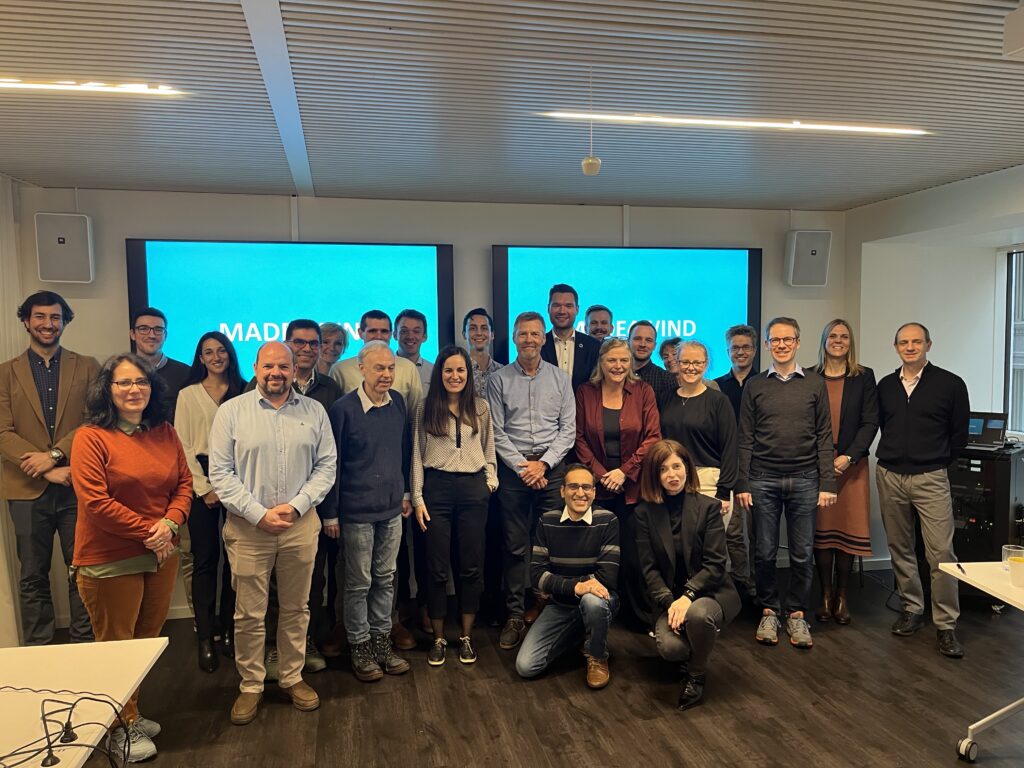
Peter Hede Broberg, researcher at Aalborg University and member of the MADE4WIND team, has been nominated for the Danish Manufacturing Research Award for his work on process modelling and defect prevention in wind turbine blade manufacturing.
Manufacturing the next generation of wind turbine blades presents a major industrial challenge. As blades become larger, manufacturers need production processes that can deliver increasingly complex composite structures while maintaining high levels of quality and reliability.
One particular challenge is the formation of fibre wrinkles during manufacturing. These defects can affect the mechanical performance of composite structures and, ultimately, the structural integrity of a wind turbine blade.
Understanding how and why they form is therefore essential to improving blade manufacturing.
This is the challenge at the heart of Peter Hede Broberg’s research.
Using process modelling to understand manufacturing defects
Peter’s research combines advanced process modelling and experimental characterisation to investigate how manufacturing defects develop and how they can be prevented.
The ambition is to move towards a more predictive approach to manufacturing: understanding material behaviour and identifying conditions that may lead to defects before the final component is produced.
As Peter explains, this can help manufacturers move closer to first-time-right manufacturing, reducing defects and supporting more automated and reliable production processes.
The research behind his nomination was conducted during his PhD within the Danish MADEBLADES project. Peter is now building on this expertise through his postdoctoral research in the European MADE4WIND project, where Aalborg University is leading the development of new manufacturing and design technologies for wind turbine blades.
From process modelling to the next generation of wind turbine blades
Within MADE4WIND, one of the main areas of research is the development of preform technology for large-scale wind turbine blade manufacturing.
Today, blade manufacturing involves labour-intensive processes for placing reinforcement materials into large blade moulds. As offshore wind turbines continue to scale up, MADE4WIND is investigating how premanufactured fibre preforms could contribute to more modular and efficient manufacturing processes.
But introducing new manufacturing approaches also requires a detailed understanding of how materials behave throughout production.
This is where process modelling becomes particularly relevant.
MADE4WIND is developing a virtual manufacturing process simulation framework to investigate and optimise different preform design and process variables. The work specifically addresses manufacturing defects including fibre misalignment, wrinkles, voids and dry spots, with the objective of minimising defects, reducing processing time and limiting material waste.
The modelling work is complemented by laboratory validation, allowing researchers to compare virtual predictions with the behaviour of materials and manufacturing processes in practice.
Towards more reliable and efficient blade manufacturing
The work forms part of a broader objective within MADE4WIND: developing blade technologies capable of supporting the continued scale-up of offshore wind.
Aalborg University leads Work Package 3, dedicated to new recyclable material, manufacturing and design technologies for wind turbine rotor blades. Alongside preform technology, the work also investigates material toughening technologies and the recovery and reuse of recycled blade reinforcement materials.
Together, these research areas aim to address several interconnected challenges in future blade manufacturing: production cost, manufacturing time, reliability, blade mass and circularity.
By combining advanced modelling, new materials, manufacturing technologies and experimental validation, MADE4WIND is working towards manufacturing processes that are better equipped for the increasingly large and complex blades required by future offshore wind turbines.
Peter’s research on process modelling and defect prevention directly contributes to this ambition.
Recognising research with industrial relevance
Peter has now been nominated for the Danish Manufacturing Research Award, established by DI – Dansk Industri and MADE, with support from ForskningsAlliancen.
The award recognises manufacturing research with the potential to address industrial challenges and contribute to the development of future production technologies.
The award ceremony will take place at Industriens Hus on 29 September 2026.
The MADE4WIND consortium congratulates Peter on the nomination and wishes him the best of luck for the award ceremony.
His work is a strong example of the research behind MADE4WIND: combining scientific knowledge with real manufacturing challenges to support the development of the next generation of offshore wind technologies.